Moving towards higher temperatures in satellite equipment: a good solution for cheaper and lighter satellite configurations
Comparison between SSPAs and TWTAs
We all know it: the smaller and lighter the object we want to put into orbit, the better. Placing kilograms into space is still expensive, even though costs have recently dropped significantly, especially for Low Earth Orbits (LEO).
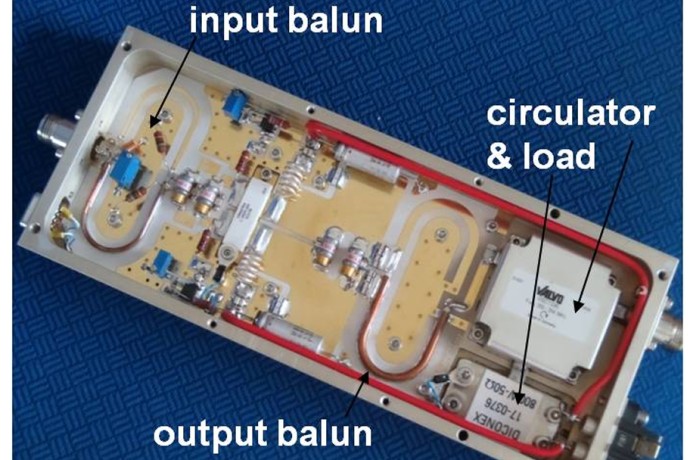
However, mass is not the only factor. The technologies used can also make a significant difference in cost. Recent trends in satellite communications have raised interest in a type of RF amplifier called Solid State Power Amplifiers (SSPAs). These are simpler in construction and therefore generally cheaper than their traditional counterparts, Travelling Wave Tube Amplifiers (TWTAs).
TWTAs make use of an electron beam, which consists of electrons accelerated by thousands of volts. The energy from this beam is coupled with an RF signal that follows a helicoidal path. The effective speed of the RF signal is then similar to that of the electron beam. As you can imagine, this is quite a complex system. SSPAs consist of one active element that is polarised and operates as a Class A amplifier. The high electron mobility of the device allows it to amplify a signal at very high frequencies.
While both devices serve the same purpose, they work in completely different ways. SSPAs are more inefficient than TWTAs, so for the same RF output power, we need to dissipate more heat. On top of that, while TWTAs are low-current, high-voltage devices, SSPAs are low-voltage, high-current devices. This means that using SSPAs could generate a lot of heat due to dissipation in the conductors, resulting in even more heat dissipation! This makes thermal management an important consideration when designing satellite systems using SSPAs.
Phased Array Antenna
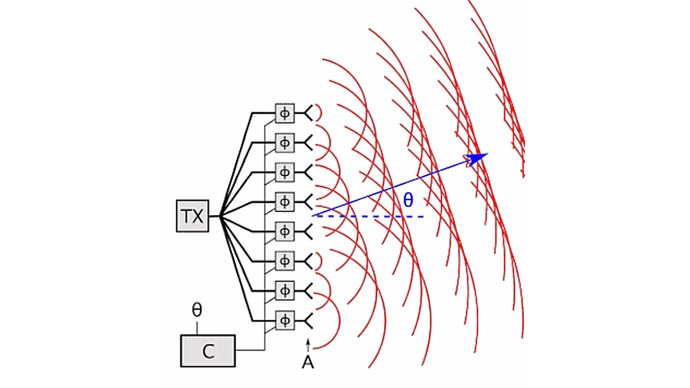
One advantage of SSPAs is their size: they can be tightly packed together and can withstand high temperatures. This is very useful for creating what is called a Phased Array Antenna. Instead of using a large parabolic reflector to direct a radiofrequency beam, phased array antennas consist of multiple small radiating elements and a delay network. With this setup, the beam is directed towards the desired position on Earth without the need for moving parts. By controlling the phase of the signal at each radiating element, the antenna can electronically steer its beam in different directions. This allows satellites to communicate with different locations without physically moving the antenna.
Power Supply Unit
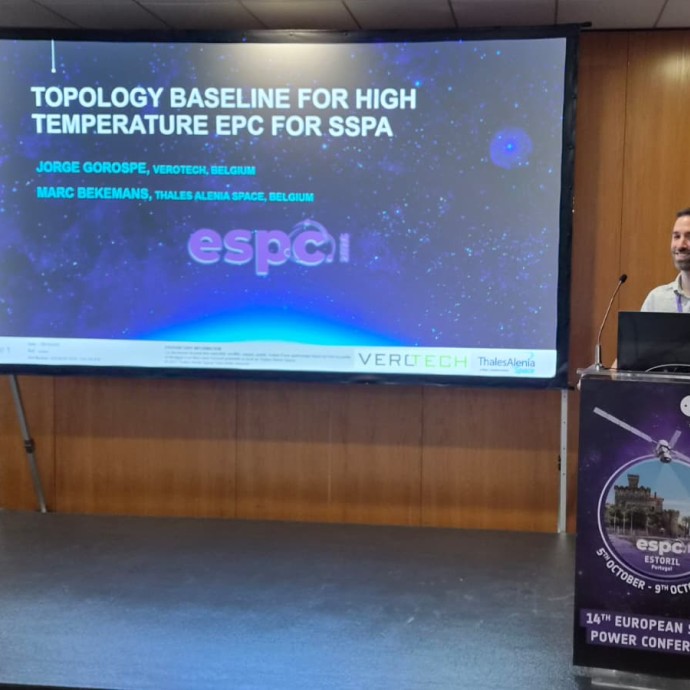
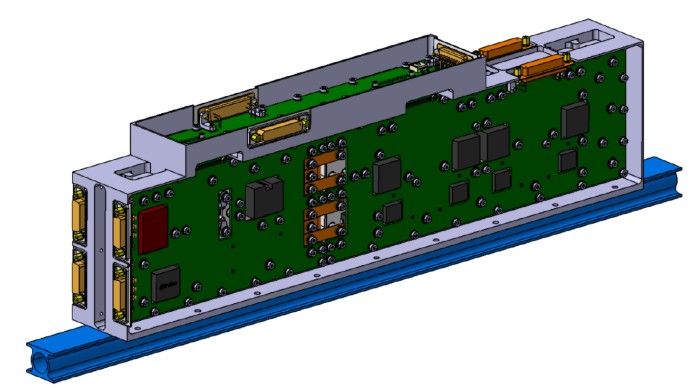
To supply these Solid State Power Amplifiers, we use DC-DC power converters, which are generally limited to operating temperatures not exceeding 85°C. As part of the ESA project High Temperature PSU for SSPA, our consultant Jorge Gorospe, within the R&I team at Thales Alenia Space, has developed a Power Supply Unit capable of operating at 85°C and above. This is intended to reduce the satellite's cooling systems and, therefore, its weight.
Another important advantage concerns the integration within the satellite. In conventional configurations, the power supply is often positioned remotely from the antenna and connected to the SSPAs through cable harnesses. By operating at higher temperatures, the new PSU allows closer integration with the antenna, offering greater flexibility at system level.
The Power Supply Unit delivers up to 1 kW of output power across eight outputs that can be configured independently or in parallel. The measured efficiencies were 94% and 93.5% at baseplate temperatures of 25°C and 85°C, respectively, under vacuum conditions.