Quantum Computing: closer than you think
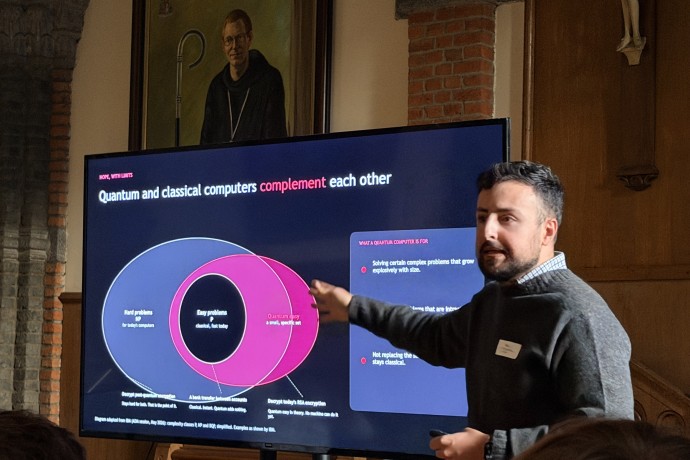
Quantum computing sounds like something for 2040. At our Tech Community session at Abdij Keizersberg, Walter Vanherle and Elias Oumouadène showed that parts of it are a lot closer.
From quantum theory to real-world problems
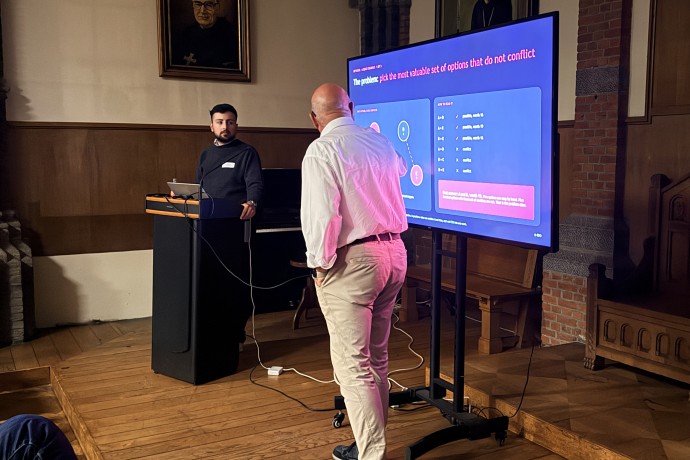
Walter, Partner at BDO Belgium and Transport & Industry Market Lead at Quantum Circle, focused on where quantum computing could make a difference in practice. Walter illustrated this with some practical cases: recalculating railway diversions after an accident or blockage while taking into account parameters such as weather, gradients and station layouts; optimising resource and asset planning, such as finding the most efficient university timetable; and freight loading optimisation.
That is where quantum becomes interesting: it offers a different way of approaching certain complex optimisation problems. And that is highly relevant to engineering, where finding the best or most efficient solution within a set of technical and business constraints is often at the heart of the work. You first need to understand the problem, identify the variables and constraints that really matter and formulate it in a way that can be solved.
Different problems, different tools
Elias, AI Strategy Manager at BDO Belgium and a member of Quantum Circle, brought the wider picture. He looked at where quantum technology stands today, what is already happening in Belgium and what organisations should be thinking about now.
AI and quantum can both help tackle problems that are difficult to solve with standard computing, but they approach them differently. AI models learn from data to find a good solution, while quantum computing is particularly interesting for problems where the number of possible combinations grows extremely quickly and the challenge is to find the best possible solution.
The discussion also went beyond quantum computing itself, covering quantum communication, quantum sensing and post-quantum cryptography. Security is particularly relevant because encrypted data can be collected and stored today with the possibility of decrypting it in the future (harvest now, decrypt later), while replacing cryptographic infrastructure can take years.
The message was not that every organisation needs to start building quantum applications tomorrow; the important thing is understanding where the technology could matter and preparing where there is already a reason to do so. Companies will not necessarily need their own quantum computer to make use of the technology either. Quantum and classical computing are expected to work together, with quantum becoming another tool alongside the CPUs and GPUs we already use. In the longer term, businesses may not need their own quantum hardware at all, but could access quantum computing as a service when a specific problem calls for it.
What does this mean for VeroTech?
This is where the topic connects with our own engineering work. VeroTech engineers work across software, electronics, mechanics, mechatronics and data science, solving complex problems where performance, cost, time, energy and other constraints often have to be balanced at once.
That makes quantum less about investing in completely new infrastructure and more about understanding which problems could benefit from this additional computing capability. Quantum will not be the right answer for every problem, and classical computing will remain essential. But understanding emerging technologies helps us recognise where a different approach could eventually create value for our clients.
The presentation introduced a practical Q-Readiness framework to help organisations identify potential use cases, prepare, connect with the right expertise, experiment with a small problem and scale what proves useful. It also included a concrete IBM quantum software development kit example showing how an optimisation problem can be modelled and solved on a classical computer today, while providing a path towards quantum approaches as the technology develops.
At its core, our engineers' work is about solving problems and finding the best possible solution. Quantum offers another way to think about how we get there, and understanding that possibility today helps us recognise where it could make sense tomorrow.
Thanks to Walter and Elias for a clear and well-grounded evening, and to everyone who joined us for the talk and drinks afterwards.
Want to go deeper? The full presentation includes the practical cases, the optimisation methodology and the Q-Readiness framework from the session:
Download the presentation