Tech Community: Einstein Telescope
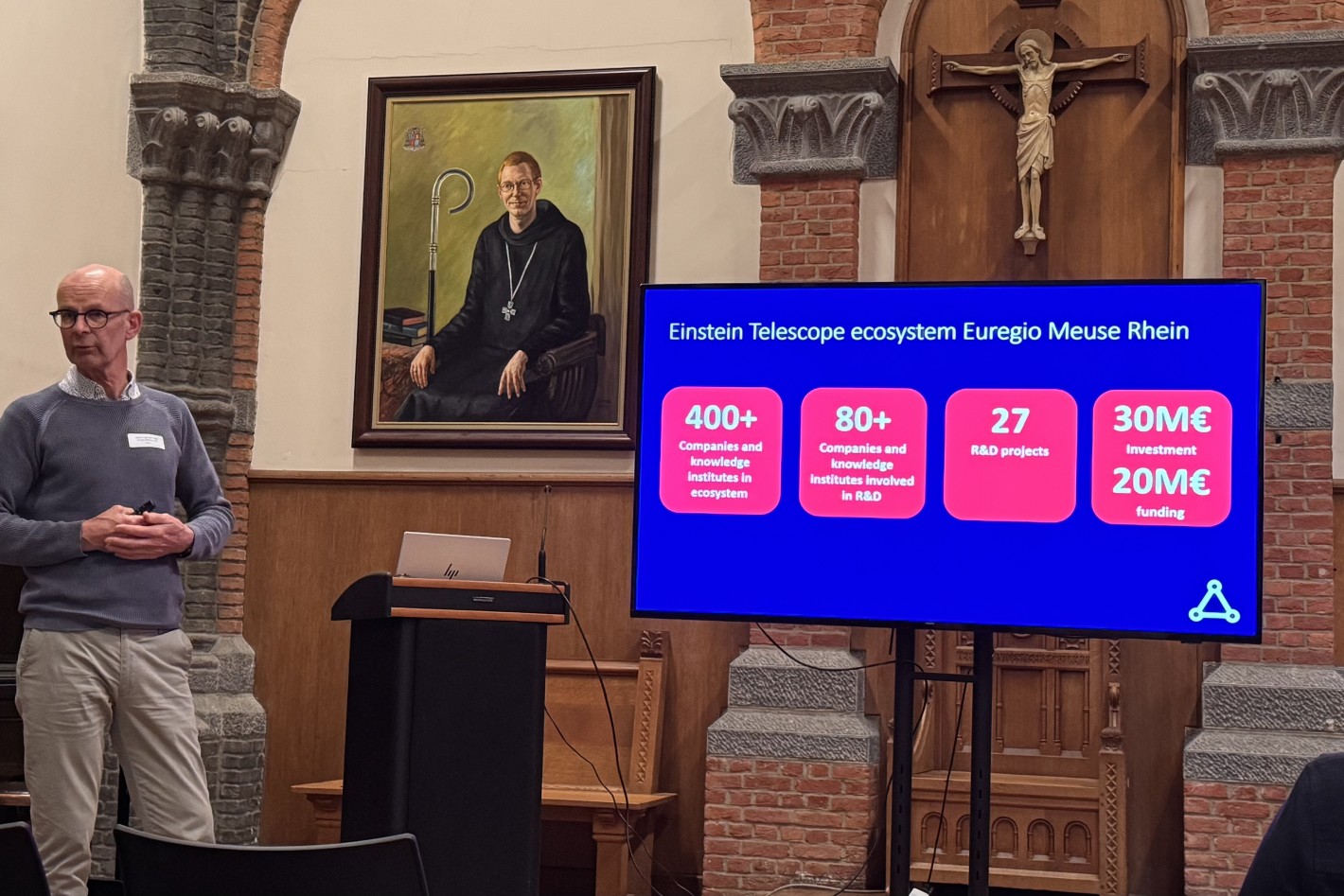
Our Tech Communities are quarterly evening events where we welcome inspiring speakers to share insights on cutting-edge and relevant topics. These sessions offer a great opportunity to stay up to date with the latest developments, learn, exchange ideas and engage in meaningful discussions in an informal setting. For our latest edition in April, we invited Gerjan van de Walle (Director of Valorization and Business Development) of the Einstein Telescope. The session offered a compelling look at the science behind the project, as well as the vast opportunities it presents alongside the significant challenges it faces. Here are our main key takeaways.
A scientific ambition built on industrial reality
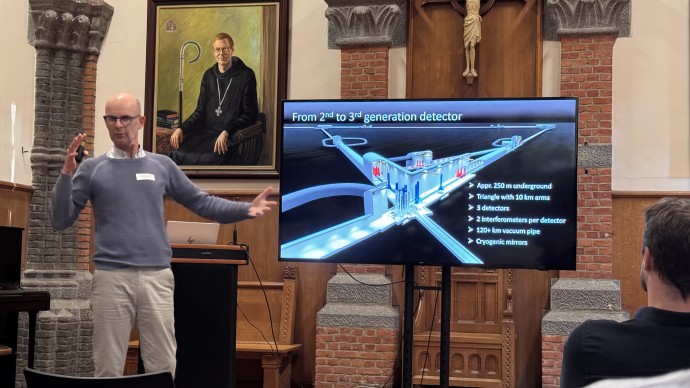
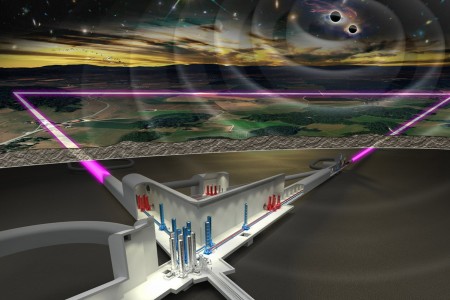
The Einstein Telescope is not just a scientific instrument in development. It is a large-scale stress test for Europe’s industrial and engineering capability. The observatory planned for the Euregio Meuse-Rhine will push measurement sensitivity to extremes never achieved before. It will detect disturbances in spacetime that are so small they are effectively invisible in any conventional engineering context.
Yet, as the discussion highlighted, the limiting factor is not theoretical physics. It is execution. The system depends on technologies that are well understood in principle but not yet proven at this scale and level of integration: cryogenic stability, ultra-high vacuum systems, vibration isolation, precision optics, and real-time control in extremely noisy environments. These capabilities already exist within European industry, but the challenge is no longer isolated invention; it is coordinated performance under extreme constraints.
The real engineering challenge: interaction effects
A key insight from the session is that none of these subsystems can be treated independently. Vibration isolation is not purely a mechanical problem; it is equally a challenge in sensing, control, and data interpretation. Cryogenics is not just about temperature management; it directly impacts material behaviour, alignment stability, and measurement noise. Signal processing is not a downstream activity; it defines what “success” even means for the physical system.
In such a context, performance emerges from interaction rather than from component excellence alone. This makes the Einstein Telescope closer in nature to aerospace or semiconductor manufacturing than to traditional large-scale scientific infrastructure.
Interdisciplinary collaboration as a foundation for innovation
Collaboration therefore becomes the defining factor. The interaction between scientists and engineers is essential: scientists define what must be measured and why it matters, while engineers determine whether it can be physically realized and maintained. This boundary is not fixed but continuously negotiated. Without tight collaboration, scientific ambition risks remaining theoretical rather than becoming technically achievable.
The same principle applies to collaboration with industrial R&D partners. It is not a supporting role but a critical one. Many of the required technologies sit at, or even beyond, current industrial capability. This means industrial partners are not simply suppliers executing predefined specifications, but co-developers of solutions that do not yet fully exist. Their contribution is essential in translating conceptual designs into systems that are not only functional, but also manufacturable, scalable, and reliable over time.